Create an Audio Transcript with Amazon Transcribe, API Gateway, Lambda, S3 and Terraform
Sample using AWS Lambda, API Gateway, S3, Amazon Transcribe, and Terraform

Software Engineer.
Based on this AWS tutorial "Create an Audio Transcript with Amazon Transcribe" we will create all the processes using AWS API Gateway, Lambda, Amazon Transcribe and S3, all with Terraform.
API Gateway endpoints
As the transcription service can take a couple of seconds to extract the speech from the audio, we need two endpoints:
The first one is a POST endpoint that triggers a lambda which will upload the audio file to an S3 bucket and trigger a transcript job, it looks like this https://xxxxxxx.execute-api.eu-west-1.amazonaws.com/dev/upload
The second one is a GET endpoint to get the result of transcription, it looks like this https://xxxxxxx.execute-api.eu-west-1.amazonaws.com/dev/transcription?code=f55c863e-60b2-4f64-9ed2-bd4b0afe0168.mp3
The terraform code of these two endpoints:
resource "aws_apigatewayv2_api" "http_api" {
  name          = "transcribe_api"
  protocol_type = "HTTP"
  description   = "HTTP API to send audio files to Lambda"

  cors_configuration {
    allow_credentials = false
    allow_headers     = []
    allow_methods     = ["GET", "POST"]
    allow_origins     = ["*"]
    expose_headers    = []
    max_age           = 0
  }
}

# Upload audio endpoint
resource "aws_apigatewayv2_integration" "api_upload" {
  api_id = aws_apigatewayv2_api.http_api.id

  integration_uri  = aws_lambda_function.upload_audit_lambda.invoke_arn
  integration_type = "AWS_PROXY"
}

resource "aws_apigatewayv2_route" "api_upload" {
  api_id    = aws_apigatewayv2_api.http_api.id
  route_key = "POST /upload"
  target    = "integrations/${aws_apigatewayv2_integration.api_upload.id}"
}

# Get transcription endpoint
resource "aws_apigatewayv2_integration" "api_transcription" {
  api_id = aws_apigatewayv2_api.http_api.id

  integration_uri  = aws_lambda_function.get_transcription_lambda.invoke_arn
  integration_type = "AWS_PROXY"
}

resource "aws_apigatewayv2_route" "api_transcription" {
  api_id    = aws_apigatewayv2_api.http_api.id
  route_key = "GET /transcription"
  target    = "integrations/${aws_apigatewayv2_integration.api_transcription.id}"
}

# Stage
resource "aws_apigatewayv2_stage" "api_stage_dev" {
  api_id      = aws_apigatewayv2_api.http_api.id
  name        = "dev"
  auto_deploy = true

  depends_on = [aws_apigatewayv2_integration.api_upload]
}
S3 bucket
resource "aws_s3_bucket" "transcript_bucket" {
  bucket_prefix = "transcript-bucket-"
  force_destroy = true
}
Lambda to upload Audio
Python code
import base64
import boto3
import json
import os
import uuid

s3_client = boto3.client('s3')
transcribe = boto3.client('transcribe')
bucket_name = os.environ['S3_BUCKET_NAME']

def lambda_handler(event, context):
    body = event['body']
    body_bytes = bytes(body, 'utf-8')

    body_base64 = base64.b64decode(body_bytes)

    name = str(uuid.uuid4()) + '.mp3'
    s3_client.put_object(Bucket=bucket_name, Body=body_base64, Key=name)
    start_transcript_job(name)

    return {
        "statusCode": 200,
        "headers": {
            "Content-Type": "application/json"
        },
        "body": json.dumps({
            "code ": name
        })
    }


def start_transcript_job(key):
    job_name = key
    job_uri = f"s3://{bucket_name}/{key}"
    transcribe.start_transcription_job(
        TranscriptionJobName=job_name,
        Media={'MediaFileUri': job_uri},
        MediaFormat='mp3',
        LanguageCode='en-US'
    )
This lambda will be triggered by the first POST endpoint mentioned before, it will then:
Extract the audio file from the body of the request
event['body'].Upload the file to S3 with a UUID, for example
0fc6f6de-0634-4a97-9734-b005f5cb1595.mp3Start a new transcript job
and finally, return the name of the user so that it can be used to get the transcription with another endpoint.
Terraform
# Lambda
resource "aws_lambda_permission" "upload_audit_lambda_permission" {
  statement_id  = "AllowExecutionFromAPIGateway"
  action        = "lambda:InvokeFunction"
  function_name = aws_lambda_function.upload_audit_lambda.function_name
  principal     = "apigateway.amazonaws.com"

  source_arn = "${aws_apigatewayv2_api.http_api.execution_arn}/*"
}

resource "aws_lambda_function" "upload_audit_lambda" {
  filename         = local.upload_audio_lambda_file_name
  function_name    = local.upload_audio_function_name
  role             = aws_iam_role.upload_audio_role.arn
  handler          = "lambda_upload_audio.lambda_handler"
  runtime          = "python3.8"
  timeout          = 25
  source_code_hash = filebase64sha256(local.upload_audio_lambda_file_name)

  environment {
    variables = {
      S3_BUCKET_NAME = aws_s3_bucket.transcript_bucket.bucket
    }
  }
}

resource "aws_iam_role" "upload_audio_role" {
  name = "${local.upload_audio_function_name}_role"

  assume_role_policy = <<POLICY
{
  "Version": "2012-10-17",
  "Statement": [
    {
      "Action": "sts:AssumeRole",
      "Principal": {
        "Service": "lambda.amazonaws.com"
      },
      "Effect": "Allow",
      "Sid": ""
    }
  ]
}
POLICY
}

resource "aws_iam_policy" "upload_audit_lambda_policy" {
  name        = "${local.upload_audio_function_name}-policy"
  description = "Policy for ${local.upload_audio_function_name}"

  policy = jsonencode({
    "Version" : "2012-10-17",
    "Statement" : [
      {
        "Effect" : "Allow",
        "Action" : [
          "logs:CreateLogStream",
          "logs:PutLogEvents",
          "logs:CreateLogGroup"
        ],
        "Resource" : "arn:aws:logs:*:*:*"
      },
      {
        "Effect" : "Allow",
        "Action" : ["s3:*"],
        "Resource" : "${aws_s3_bucket.transcript_bucket.arn}/*"
      },
      {
        "Action" : ["transcribe:*"],
        "Resource" : "*",
        "Effect" : "Allow"
      }
    ]
  })
}

resource "aws_iam_role_policy_attachment" "upload_audio_role_policy_attachment" {
  role       = aws_iam_role.upload_audio_role.name
  policy_arn = aws_iam_policy.upload_audit_lambda_policy.arn
}

locals {
  upload_audio_function_name    = "Upload_Audio_Lambda"
  upload_audio_lambda_file_name = "lambda_upload_audio.zip"
}
Lambda to get the transcription
Python code
import boto3
import json
import urllib.request

transcribe = boto3.client('transcribe')

def lambda_handler(event, context):
    job_name = event['queryStringParameters']['code']
    transcript = get_transcription(job_name)

    return {
        "statusCode": 200,
        "headers": {
            "Content-Type": "application/html"
        },
        "body": transcript
    }

def get_transcription(job_name):
    status = transcribe.get_transcription_job(TranscriptionJobName=job_name)
    if status['TranscriptionJob']['TranscriptionJobStatus'] in ['COMPLETED', 'FAILED']:
        s3_url = status['TranscriptionJob']['Transcript']['TranscriptFileUri']
        with urllib.request.urlopen(s3_url) as url:
            response = url.read()
            json_response = json.loads(response.decode('utf-8'))
            return json_response['results']['transcripts'][0]['transcript']
    else:
        return 'Code not exist, or transcription result not ready.'
This lambda will be triggered by the second GET endpoint mentioned before, it will then:
Extract the job code, for example
f55c863e-60b2-4f64-9ed2-bd4b0afe0168.mp3Make a
get_transcription_job, if the status is COMPLETE it simply returns the transcription result in the body.
Terraform
# Lambda
resource "aws_lambda_permission" "get_transcription_lambda_permission" {
  statement_id  = "AllowExecutionFromAPIGateway"
  action        = "lambda:InvokeFunction"
  function_name = aws_lambda_function.get_transcription_lambda.function_name
  principal     = "apigateway.amazonaws.com"

  source_arn = "${aws_apigatewayv2_api.http_api.execution_arn}/*"
}

resource "aws_lambda_function" "get_transcription_lambda" {
  filename         = local.transcription_lambda_file_name
  function_name    = local.transcription_function_name
  role             = aws_iam_role.upload_audio_role.arn
  handler          = "lambda_get_transcription.lambda_handler"
  runtime          = "python3.8"
  timeout          = 25
  source_code_hash = filebase64sha256(local.transcription_lambda_file_name)
}

resource "aws_iam_role" "transcription_role" {
  name = "${local.transcription_function_name}_role"

  assume_role_policy = <<POLICY
{
  "Version": "2012-10-17",
  "Statement": [
    {
      "Action": "sts:AssumeRole",
      "Principal": {
        "Service": "lambda.amazonaws.com"
      },
      "Effect": "Allow",
      "Sid": ""
    }
  ]
}
POLICY
}

resource "aws_iam_policy" "transcription_lambda_policy" {
  name        = "${local.transcription_function_name}-policy"
  description = "Policy for ${local.upload_audio_function_name}"

  policy = jsonencode({
    "Version" : "2012-10-17",
    "Statement" : [
      {
        "Effect" : "Allow",
        "Action" : [
          "logs:CreateLogStream",
          "logs:PutLogEvents",
          "logs:CreateLogGroup"
        ],
        "Resource" : "arn:aws:logs:*:*:*"
      },
      {
        "Action" : ["transcribe:*"],
        "Resource" : "*",
        "Effect" : "Allow"
      }
    ]
  })
}

resource "aws_iam_role_policy_attachment" "transcription_role_policy_attachment" {
  role       = aws_iam_role.transcription_role.name
  policy_arn = aws_iam_policy.transcription_lambda_policy.arn
}

locals {
  transcription_function_name    = "Get_Transcription_Lambda"
  transcription_lambda_file_name = "lambda_get_transcription.zip"
}
Give it a try
To run all this, just follow these steps:
$ git clone https://github.com/laidani/Create-an-Audio-Transcript-with-Amazon-Transcribe-API-Gateway-Lambda-and-Terraform
$ cd Create-an-Audio-Transcript-with-Amazon-Transcribe-API-Gateway-Lambda-and-Terraform

$ terraform init
$ terraform apply --auto-approve
In the end, you will get the API URL

Now you can use postman for example to upload an audio file:
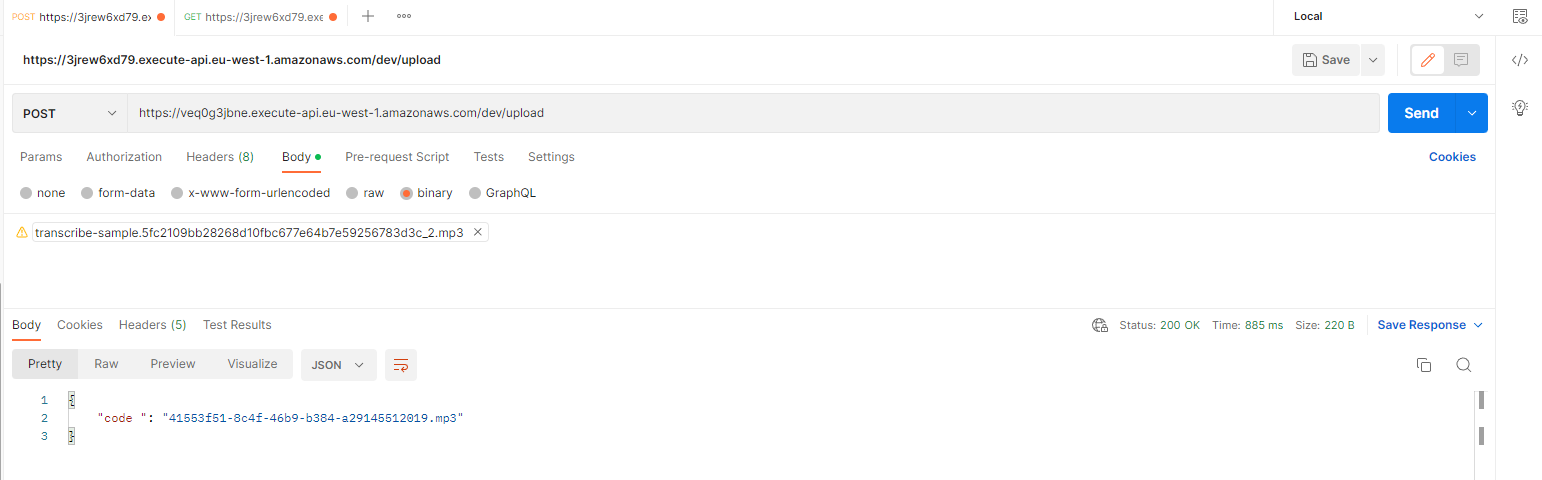
And in a few seconds, you can call the GET transcription endpoint
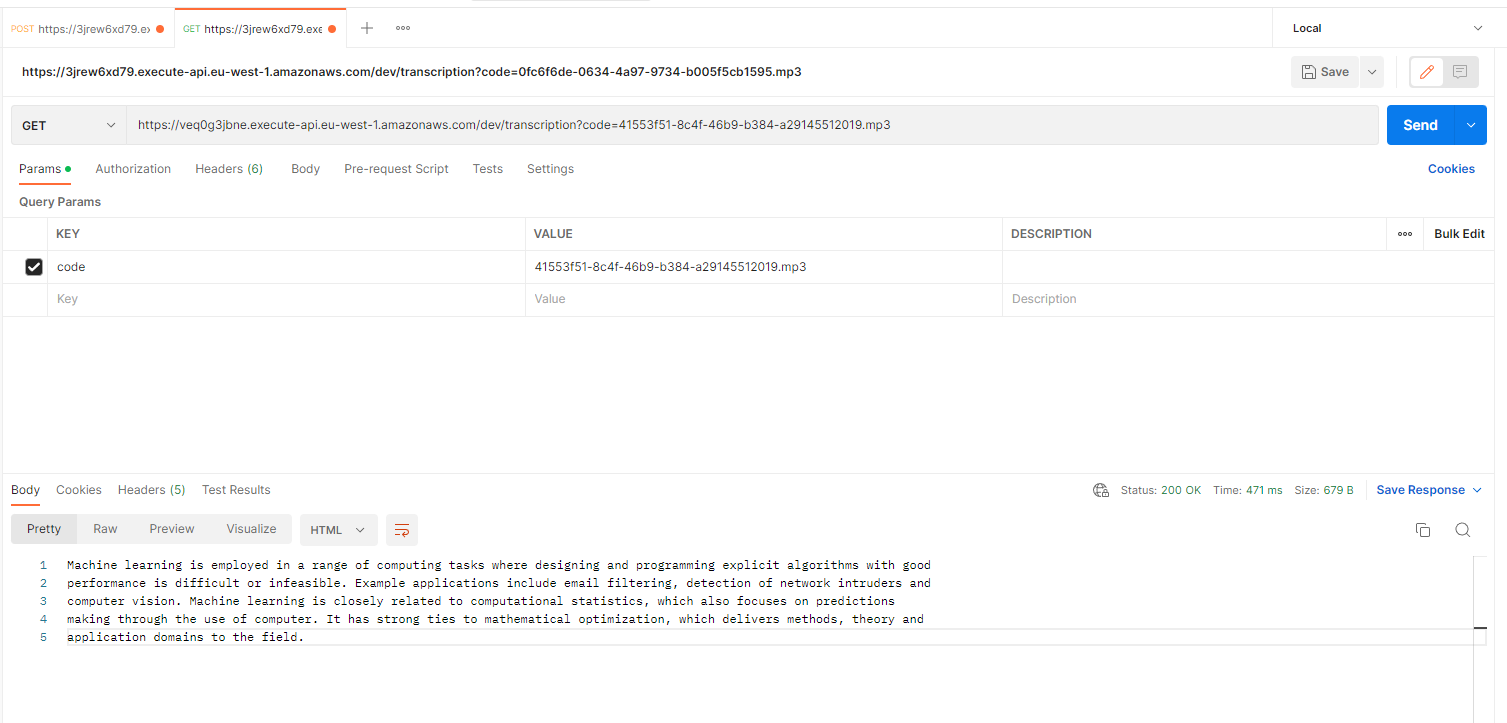
To destroy everything you just execute this command:
terraform apply --destroy --auto-approve
GitHub repository
You can find all the code written in this tutorial at https://github.com/laidani/Create-an-Audio-Transcript-with-Amazon-Transcribe-API-Gateway-Lambda-and-Terraform
Enjoy :)


